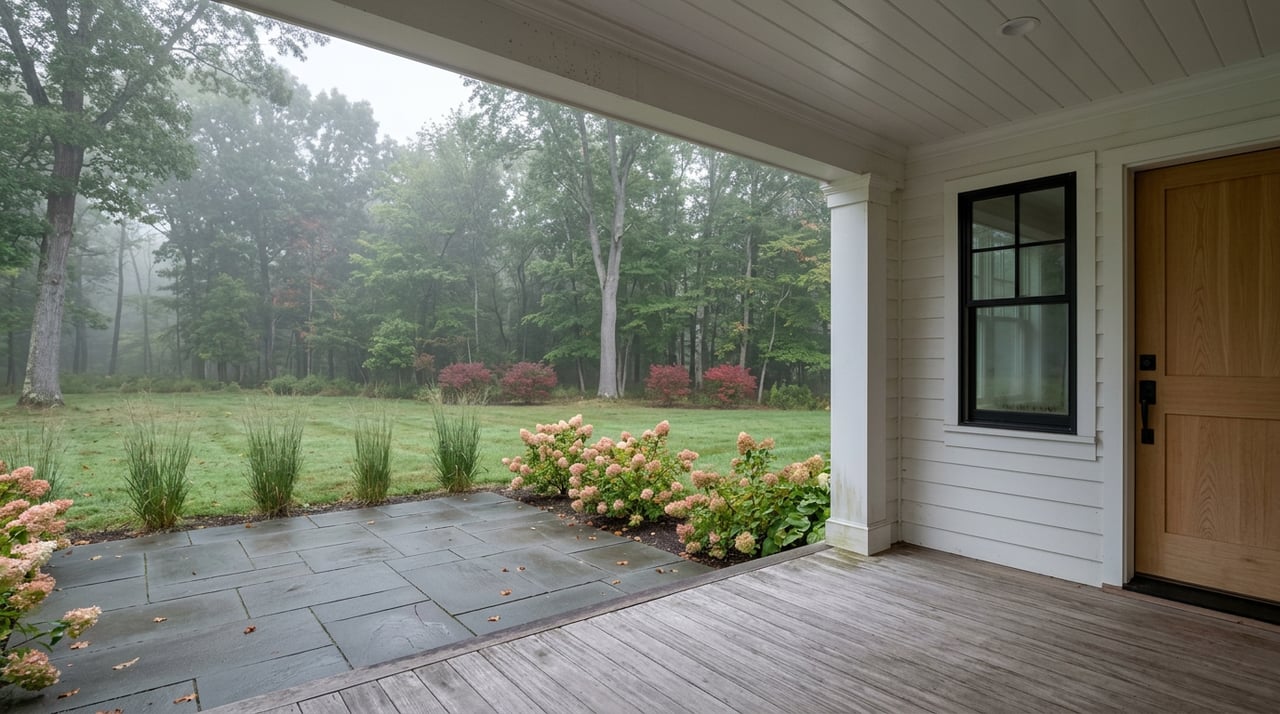
Drive through most Chicago suburbs on a July evening and you will find the social calendar tacked to a bulletin board outside a coffee shop, sponsored by a downtown business association, funded in part by whoever paid for the banner over Main Street. Tower Lakes does not have a Main Street. It has no restaurants, no shops, no post office, and by the village's own description, no commercial buildings of any kind within its borders. And yet on a Saturday in August, the place is as socially busy as any town twice its size.
That is not an accident of small-town charm. It is the direct result of two structural facts about Tower Lakes that most people never connect: the lake bans motors, and the village has nothing to sell. Together, those two absences forced residents to build their own hospitality infrastructure instead of renting one from a business. Understanding that mechanism explains almost everything about how a summer Saturday here actually unfolds.
A social calendar older than the village government itself
Tower Lakes was not incorporated as a municipality until 1966. But the organization that actually runs its lakes and parks, the Tower Lakes Improvement Association, was chartered in 1931, more than three decades earlier. That ordering matters. In most towns, the government comes first and civic life fills in around it. Here, a volunteer association was managing shared recreation before there was a village hall to manage anything else.
That association, still known by residents as the TLIA, is the reason Tower Lakes has a recognizable event calendar at all. According to the village's own overview of community life, neighbors organize winter events, a springtime Progressive Dinner, a days-long Fourth of July celebration, and a fall Chili Cook-Off, all volunteer-run. There is no chamber of commerce sponsoring any of it, because there is no commerce to speak of. Compare that to a town like Long Grove, where the fall calendar is shaped by returning restaurant operators reopening storefronts on the historic block, or Lake Zurich, where the downtown restaurant map and the lakefront event calendar have grown into each other over the past several summers. Tower Lakes never had that option. Its social infrastructure had to be homemade from the start, and it still is.
Getting to the water requires your own boat
The village's two lakes total more than 85 acres. A Lake County survey of the lake system found that recreation there had consisted of boating with no motors of any kind allowed, along with swimming and fishing, for more than 70 years at the time of that report, a rule the private lake association has maintained ever since. There is no marina renting pontoons for the afternoon. There is no boat livery. If you want to get out on the water, you need a canoe, a kayak, a rowboat, or a paddleboard, either your own or a neighbor's you have arranged to borrow.
That single rule changes the texture of a Tower Lakes summer more than almost anything else. Getting to Play Island, the free beach at the heart of the lake system, means paddling over or crossing by bridge, not motoring in. Rest Island, connected by its own bridge, functions as the quiet counterpart, a grassy spot for a picnic blanket or a hammock rather than a crowd. Neither island has a snack stand or a rental counter. What you bring is what you have for the afternoon, which is exactly the kind of friction that a marina town never makes you think about.
The five parks locals actually use, and for what
Beyond the lakes themselves, Tower Lakes has five named parks scattered through its roughly one square mile: Murray Park, Barsamian Park, Hussisian Park, Bays Park, and Gordon Lewis Park. None of them are large. None of them have a website or a reservation system. What they have is a rotation, and residents who have lived here long enough know which one fits which part of the day.
- Early morning: a smaller park closer to home for a dog walk before the heat sets in
- Midday: a shaded corner for a quiet picnic away from beach traffic
- Evening: whichever park sits closest to the lake, for the last light before dinner
The village protects sightlines to these parks and lakes through its own zoning and building ordinances, specifically to preserve access to and views of the water. That is a deliberate policy choice, not a happy accident of geography. A village with no commercial tax base has chosen to spend its limited regulatory attention on keeping the water visible and reachable for the people who already live here, rather than on attracting the kind of development that might otherwise have filled in those views.
When nobody is in charge of the fun
The organized calendar only tells part of the story. The village's own description of daily life notes something that will sound familiar to anyone who has actually lived through a Tower Lakes winter: it is not unusual to see a group of young adults throw together a spontaneous hockey game in the middle of the ice-covered lake while parents teach their younger kids to skate closer to shore. Nobody schedules that. Nobody needs to. When the shared amenity is a frozen lake instead of a warming hut with rented skates, the fun organizes itself around whoever shows up.
That same self-organizing instinct shows up in warmer months too, in the informal garage sales and estate sales neighbors post to each other directly, in the driveway conversations that substitute for a coffee shop counter, in the small errands, like arranging a snowplow or a leaf pickup, that get solved through a direct ask rather than a Google search for a local business. None of this is unique to Tower Lakes in isolation. What is unique is how much of it exists because there is genuinely no commercial alternative. The absence is the feature.
What this actually means if you already live here
None of this is a pitch. If you already live in Tower Lakes, you already know the rhythm: the lake before the parks, the parks before the calendar, the calendar before anything you would call an errand. What is worth naming, if you have never quite put it into words, is why that rhythm exists at all. It is not nostalgia. It is a direct consequence of two rules the village has kept in place for decades, one on the water and one on the ledger.
Most of the northwest suburbs solve for convenience first and community second, building a downtown and letting the social calendar follow the businesses that fill it. Tower Lakes solved it in the other order, and has now had close to a century of practice at running that arrangement well. Whether that trade continues to work depends on the same volunteer structure it has always depended on, the same TLIA, the same neighbors willing to run a chili cook-off table or organize a progressive dinner route. It has held for this long. There is no obvious reason it stops holding now.
If you have questions about how a neighborhood like this actually functions day to day, whether you are a longtime resident thinking ahead or simply curious how a place with no storefronts keeps its calendar this full, the team at Morrison Home Team spends its time in exactly these details across Barrington and the surrounding villages. Reach out any time you want a conversation grounded in how a neighborhood actually works, not how it looks from the highway.