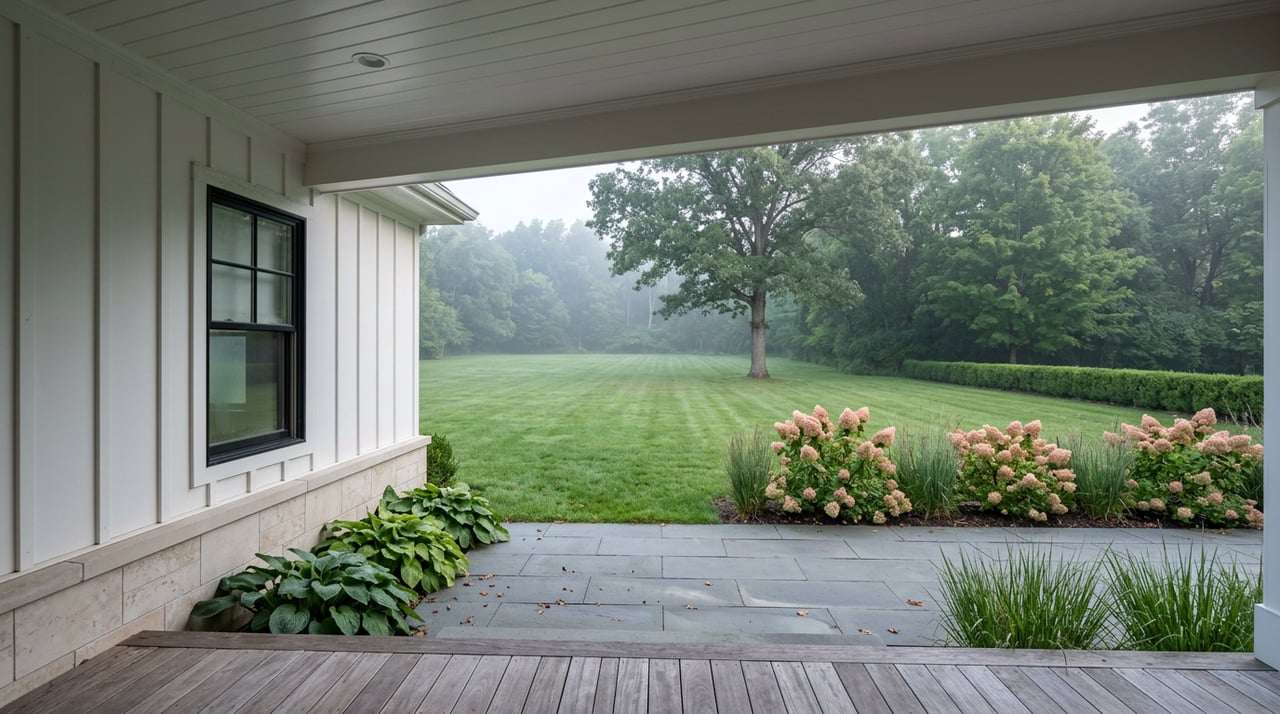
Two five-acre parcels can sit half a mile apart in Barrington Hills, carry the same Barrington 220 school assignment, share a mailing address format, and still land their owners in front of two completely different tax offices when the bill arrives. The village line tells you almost nothing about what you'll actually pay. The county line tells you everything.
Most buyers comparing listings assume "Barrington Hills" means one market with one set of rules. It doesn't. It means one village government layered on top of four separate county tax systems, and the difference between them shows up as real money every single year you own the property.
One Village, Four Counties
Barrington Hills was built this way from the start. The village incorporated in 1957 out of northwest Cook County, then annexed land in Lake and McHenry counties by 1959, then absorbed the village of Middlebury in Kane County in 1962. What resulted is a single municipality that today straddles roughly 29 square miles across four counties: Cook, Kane, Lake, and McHenry.
That history matters because Illinois doesn't assess or tax property at the village level. Counties do. Each county runs its own assessor's office, its own equalization process, and its own mix of overlapping levies for schools, parks, fire protection, and libraries. The village sets zoning. The county sets your tax bill. Two different governments, two different jobs, one parcel.
The zoning side stays consistent no matter which county you land in. A minimum five-acre lot size has applied to new construction village-wide since 1963, and it hasn't moved. As Village Clerk Nikki Panos put it, "Minimum 5-acre zoning is within the village code, so our spaces are well-protected and maintained." That consistency is part of what buyers pay for here. The tax side doesn't share that consistency at all.
What the Rate Spread Actually Costs You
Effective property tax rates, meaning the actual annual bill divided by market value, currently run meaningfully different across the three Barrington Hills county segments with published data:
| County portion | Effective tax rate |
|---|---|
| Cook County | 1.87% |
| Lake County | 2.34% |
| Kane County | 2.80% |
These figures come from Ownwell's Cook County, Lake County, and Kane County property tax data for Barrington Hills. We couldn't locate a comparably reported effective rate for the village's McHenry County slice, but the same administrative logic applies there too: a separate county assessor, a separate levy structure, a separate number on your bill.
Run those percentages against a real number and the gap stops being abstract. Barrington Hills homes sold at a median price of $1.2 million in March 2026, according to Redfin data cited in our own recent look at the village's estate market. Apply each county's effective rate to that figure and the annual tax bill on an otherwise identical home moves from roughly $22,440 in the Cook County portion, to about $28,080 in the Lake County portion, to close to $33,600 in the Kane County portion. That's an $11,160 swing every year between the least and most expensive tax jurisdiction inside the same village, on the same style of home, with the same village services and the same school district. Hold the property for ten years and that gap alone tops six figures.
Why This Catches Buyers Off Guard
Nobody markets a five-acre equestrian estate by county. Listings lead with the barn, the paddock, the trail access, the privacy buffer. The village brand does the rest. So buyers comparing two properties that look nearly identical on paper often never check which county actually holds the parcel until the closing disclosures land in their inbox, well past the point of easy comparison shopping.
The fix is simple but easy to skip. Before you write an offer, confirm the county from the legal description or the recorded property index number, not the mailing address or the ZIP code, since those can be misleading across a village this fragmented. A title company or closing attorney can verify jurisdiction in minutes. Ask for it before you fall in love with the house, not after.
This is also why comparing two listings purely on price per square foot or acreage inside Barrington Hills can mislead you in a way it wouldn't in a single-county suburb. The number on the listing sheet doesn't carry the tax jurisdiction with it. You have to go get that separately.
The Market You're Actually Buying Into Right Now
The tax mechanics matter more right now because the Barrington Hills market has been moving. Redfin data showed the median sale price at $1.1 million in January 2026, up 12.2% year over year, with price per square foot up 26.4% over the same period. By March 2026, the median had climbed to $1.2 million, though the pace slowed considerably on the way there: a median of 218 days on market and only three homes sold that month, which tells you this remains a thin, selective market rather than a fast-moving one.
New construction is testing the top of that range. A newly built 11,600-square-foot home on 5.3 acres at 101 South Remington Drive hit the market in April 2026 asking $6 million, one of only a handful of Barrington Hills area listings to clear that mark in recent memory. On the resale side, a 10,000-square-foot castle-motif mansion on six acres, built in 1975 and later remodeled with turrets and battlements, closed in March 2026 for $1.2 million, roughly $700,000 below its original 2023 asking price. That gap between ambitious asking prices and what buyers actually pay is a pattern worth watching if you're pricing a sale or sizing up an offer.
None of that context changes the tax mechanism underneath it, but it does change how much the mechanism is worth understanding. A tax gap of $11,160 a year matters more when you're already weighing a purchase in the $1.2 million range and negotiating against 218 days of market patience on the seller's side.
If you're on the selling side of that equation rather than buying, our closer look at positioning acreage and luxury inventory in Barrington Hills covers how pricing strategy shifts when your buyer pool is this selective.
A Few Questions Buyers Ask Once They Know This
Does the school district change based on which county my lot is in? No. Barrington Community Unit School District 220 already spans all four counties Barrington Hills touches, so a change in county tax jurisdiction doesn't mean a change in school assignment.
Does the five-acre zoning minimum apply the same way in every county? Yes. That restriction has applied village-wide since 1963 regardless of which county the parcel falls in. Zoning is a village decision. Taxation is a county decision. They don't move together.
How do I confirm which county a specific listing falls in before I make an offer? Ask your agent or closing attorney to pull the legal description and property index number before you go under contract. The county's format for that number will confirm jurisdiction faster than any address lookup.
Buying in Barrington Hills Deserves a Second Look at the Fine Print
The village sells privacy, acreage, and a five-acre buffer that hasn't changed since 1963. What it doesn't sell you upfront is which of four separate tax systems your specific parcel falls under, and that single fact can be worth tens of thousands of dollars over a normal hold period. If you're comparing estates here, or anywhere else in the northwest suburbs, Morrison Home Team can walk the county-level detail with you before you write an offer, not after. Request Your Free Home Valuation and let's look at what a specific parcel actually costs to own, not just what it costs to buy.